 Afterhue
How to find the best sunset spot near you
A good sunset spot has a clear view toward the sunset bearing, some height or open water, a foreground worth including and safe access in the half hour after dark. Scout it in daylight, check the sun's direction for the season, and keep a backup. The best viewpoint changes through the year.
Coming soon to iPhone
What makes a good sunset spot?
Five things matter more than any famous name. A clear line of sight toward where the sun sets, so no building or hill cuts the sun early. Some elevation or open water, which widens the sky. A foreground, such as a pier, a tree or a skyline, to give the picture scale. Safe access, including a way home when it is dim. And some space, so you can move around while the light changes.
What kinds of spots work, and what are the trade-offs?
| Spot type | Strength | Weakness |
|---|---|---|
| Beach or shoreline | Wide horizon, reflections | Crowds, tide, wind |
| Hilltop or ridge | Height, long views | Hike in the dark, wind |
| Rooftop or high floor | Easy, city skyline | Access rules, glare on glass |
| Lake or reservoir edge | Calm reflections | Mosquitoes, limited access |
| Open field | Quiet, large sky | Little foreground |
| Bridge or pier | Strong foreground | Traffic, safety limits |
How do I check which way to face?
The sun sets in a different place each season. In the Northern Hemisphere it sets northwest in spring and summer, and southwest in autumn and winter, which means a perfect spot in June might point the wrong way in December. Our guide to which direction the sun sets has a table of bearings. Use the free NOAA solar calculator for your date and place, then match it with a map.
How do I scout from my sofa?
Open a map in satellite view and draw a line from your candidate spot along the sunset bearing. If the line crosses a large building or a hill within a couple of kilometers, the sun will vanish early. If the line crosses open water, farmland or a flat skyline, the view is clear. Then check street-level photos for trees and fences. Ten minutes of map work saves a wasted evening.
- Pick three candidates within a reasonable distance.
- Look up the sunset bearing for the date you plan to go.
- Draw the line from each spot along that bearing.
- Rule out any with a blocked line.
- Visit the best one in daylight and check parking, paths and lighting.
What should I look for when I visit?
Stand where you intend to stand and face the bearing. Note what sits at the horizon. Check where the sun will be in relation to it. Ask yourself whether you could move a few steps to improve the frame. Look behind you for the east sky, which may glow pink after sunset. Look down for a safe path back, since you will walk in dim light.
- Is there a stable place to rest a phone?
- Is the ground safe, dry and free of drop-offs?
- Where do people park, and when does the gate close?
- Is there a second spot nearby with a different angle?
How do I use a forecast to choose among spots?
Weather changes over short distances. A coast and an inland town can get different skies the same evening, and a spot with a low bank of cloud to its west is worth skipping on a night when another spot is clear. A forecast that looks at the path of the light helps. The Glow Score reads the weather at your place and at a point about 150 km toward the sun and shows reasons such as Clear to the west.
Can Afterhue keep my spots?
In a limited way. You can save places in the app, each stored as a city name and nothing more, and each shows its current band and sunset time. The free plan keeps one place, and Pro allows up to 10 with Glow alerts for each. The app does not find viewpoints or store coordinates. It is useful for comparing a home spot, a weekend town and a trip. See outlook and places for details.
How can I find spots in a city?
Look up, not out. Rooftops, parking garage tops, bridges, waterfront promenades and parks on hills are the usual choices. Ask building managers about rooftop access, and check opening hours for public terraces. In dense areas, the street grid itself can act as a frame: a long east-west avenue lines the sun up between buildings on a few days of the year, and people gather for it. Mark those dates in your calendar if you find one.
How do I keep a list of what I find?
A simple note works: the place, the best months, what blocks the view and how long it takes to get there. Add a photo from each visit. If you use Afterhue, each photo you turn into a Hue Chip keeps the city, the date and the time, and the Places row in Collection lists each place that has a chip, with the number of sunsets and your best one. That gives you a record of where you had good evenings.
What if the best spot is crowded?
Move a short distance along the bearing. Ten minutes up the shore or a street over often gives the same sun with a fraction of the people. Or arrive earlier than everyone and leave later, since the afterglow draws fewer visitors than the sunset itself. Choose a second-best view you can enjoy in peace over a famous one you share with a hundred phones.
What safety rules should I follow?
Plan to leave in the dark. Bring a light, tell someone where you are going and check the tide if you are on a shore. Respect private land and closing times. Do not climb on barriers or stand near drop-offs for a photo. If the weather turns, go home. A sunset happens again tomorrow.
How do I decide between two good spots?
Choose the one that suits the sky you expect. High, thin clouds favor a wide horizon. A clearing storm favors a place with a long view to the west. A calm evening favors water. If you are unsure, go to the one you can leave from most easily. Then keep a note of how it worked, so next time you know.
Frequently asked questions
How do I find a good sunset spot near me?
Look for a clear view along the sunset bearing, check it on a satellite map, and visit in daylight to check access and safety.
What makes a sunset viewpoint good?
An open line toward the setting sun, some height or water, a foreground and safe access in low light.
Does the best spot change through the year?
Yes. The sun sets farther north in summer and farther south in winter, so a spot that frames the sun in June may not in December.
Can Afterhue find sunset spots for me?
No. It stores places as city names, shows each one's sunset time and score, and lets you compare them.
Should I go early?
Yes. Arrive 30 minutes before sunset to find a position, and stay 20 minutes after for the afterglow.
Keep exploring
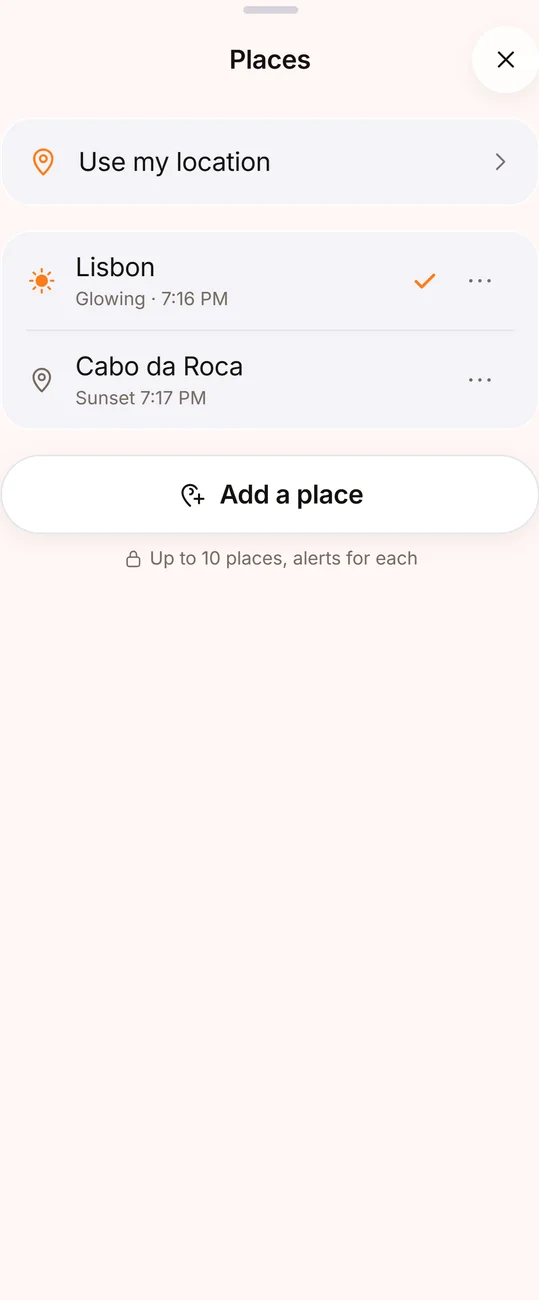 3-Day Sunset Outlook and Saved PlacesThree days of sunsets and sunrises as ranges, and up to 10 saved places with alerts.
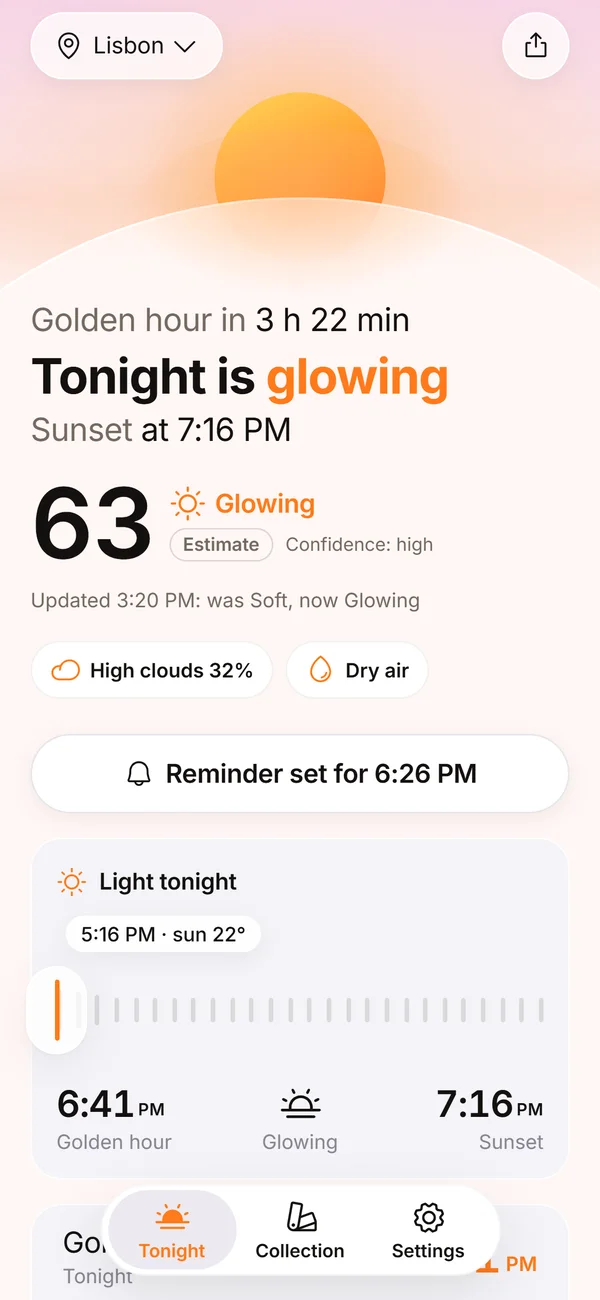 Sunset Glow Score0 to 100, four bands, up to three reasons, and a score that learns from your ratings.How to Photograph a Sunset With Your iPhoneA practical sunset routine for iPhone: timing, tap-and-hold exposure lock, composition and what to do after the sun sets.