 Afterhue
A sunset score that shows its reasons
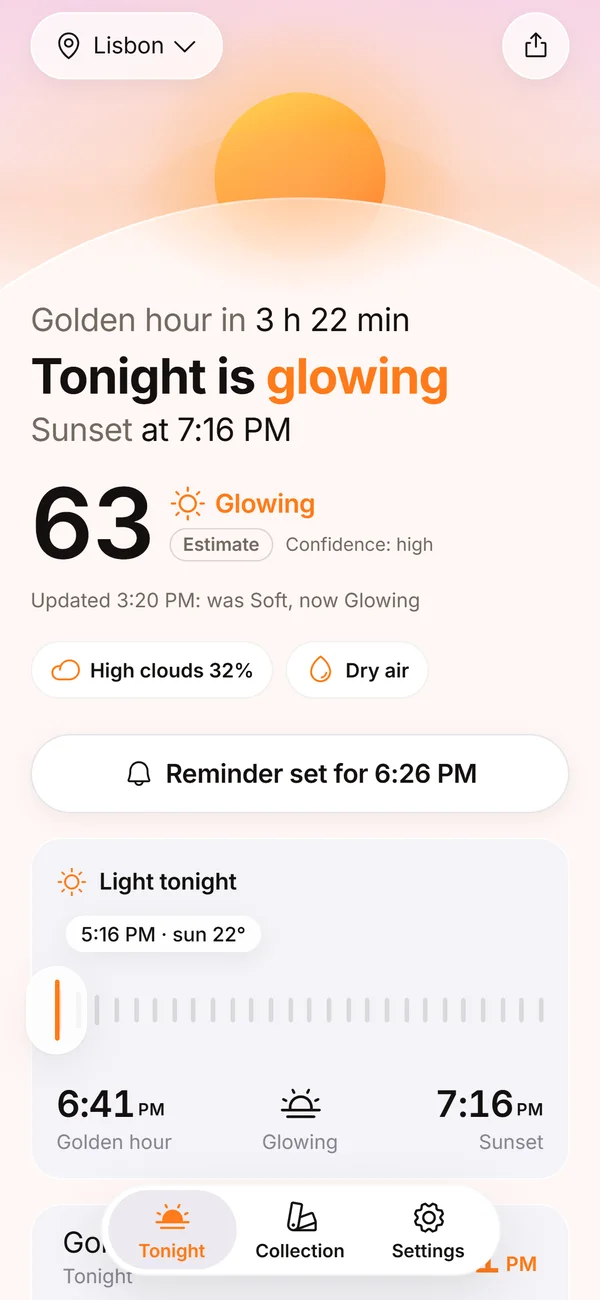
The Glow Score is Afterhue's estimate of how colorful tonight's sunset may be, from 0 to 100. It reads high and mid clouds, low clouds toward the sunset, air dryness and rain, then shows up to three reasons next to the number. It is an estimate and is labeled that way.
Coming soon to iPhone
What does the Glow Score measure?
It measures how likely the sky is to light up around the moment of sunset. Afterhue reads the weather forecast for the hour of sunset at two points: your place, and a point about 150 km toward the setting sun. The second point matters because the light travels along that path before it reaches you.
The result is a number from 0 to 100 and one of four band words.
| Score | Band | What to expect |
|---|---|---|
| 0-24 | Flat | Little color expected |
| 25-49 | Soft | Some warm light, gentle color |
| 50-74 | Glowing | Good chance of a colorful sky |
| 75-100 | On fire | Conditions line up for strong color |
Which weather factors go into it?
Four things, each tied to how sunsets work. The guide to what makes a good sunset explains the physics in plain language.
- High and mid clouds. Thin cloud at altitude catches red and orange light. A clear sky gives gentle color. A thick ceiling gives less.
- Low clouds to the west. If they sit between you and the sun, the light never reaches the canvas above.
- Air. Dry air with good visibility keeps colors saturated. Humid or hazy air dulls them.
- Rain clearing. Rain that stops before sunset adds a chance of strong color.
What are the reason chips under the score?
Up to three short chips, sorted by how much each one moved the score. Examples from the app: High clouds 32%, Clear to the west, Dry air, Hazy air, Rain clearing, Thick overcast. Tap the score or a chip to open the Why sheet, which writes each factor out as a sentence.
The point is that you can disagree. If the chip says clear to the west and you can see a bank of cloud there, you know the model missed something and you can decide for yourself.
How confident is the score?
Each score carries a confidence level of high, medium or low. Evenings that are close in time and have steady cloud forecasts rate higher. Days further out change more, so the 3-day outlook shows a range such as Glowing 52-68 instead of a single figure.
If the forecast changes during the day, the screen says so: Updated 3:20 PM, was Soft, now Glowing.
How does Afterhue learn from my ratings?
After sunset, a How was it? row offers four buttons: Flat, Soft, Glowing and On fire. Each rating compares what you saw with what the app predicted an hour before sunset. After three ratings in the same area, the app shifts tonight's score by a running average of its misses, limited to 15 points either way. Your ratings stay on the phone.
The Why sheet shows the tally, for example: your sky, last 10 calls, 6 right, 3 close, 1 off. Right means the same band, close means the next band over, and off means further than that.
What does the Tonight screen show around the score?
The headline follows the band: Tonight looks flat, Tonight looks soft, Tonight is glowing, or Tonight could be on fire. Under it come the number, the word Estimate and a countdown such as Sunset in 42 min, which turns into Sunset was 12 min ago once the sun is down.
A Light tonight block lists golden hour, sunset and blue hour, and a timeline lets you drag through the evening to read the sun's height in degrees at any minute.
How do the chips read together?
One chip says little, and the set tells the story. High clouds 40% with Clear to the west and Dry air is the combination the model rewards most: there is cloud to catch the color, a clear path for the light and clean air.
Low clouds to the west cuts the score sharply even when the clouds overhead are ideal, because a blocked path matters more than the canvas. Clear sky, gentle color means the air is fine but nothing is there to light up, so expect a soft gradient. Thick overcast usually sits at the bottom of the scale.
How is this different from the cloud percentage in a weather app?
A weather app gives one cloud figure for where you stand. That figure cannot separate thin cirrus from a low gray lid, and it says nothing about the sky 150 km toward the sun. The Glow Score splits clouds by height, probes the western path, and adds air and rain. Your own eyes still win in the last hour, because you can see a cloud bank the model missed.
| Question | Cloud % in a weather app | Glow Score | Your window |
|---|---|---|---|
| Cloud height | One total | Low, mid and high separately | By eye |
| Path of the light | Not covered | Second point 150 km toward the sun | By eye, at the horizon |
| Reasons shown | No | Up to three chips | Not applicable |
| Days ahead | Yes | Yes, as ranges | No |
How should I rate an evening so the score learns?
Rating takes one tap, and a few habits make it more useful.
- Rate the best color you saw, which is often after the sun is down and not at the moment of sunset.
- Rate the flat evenings too. The tally counts right, close and off, and a run of Flat nights teaches the score as much as a spectacular one.
- Skip the rating if you were not watching, because a guess only adds noise.
- Remember the comparison is against the call made an hour before sunset, so a later forecast change does not hide a miss.
What if there is no forecast?
Sun times are computed on the iPhone, so they keep working offline. If the forecast cannot load, the score is hidden and the screen says the forecast is taking a break. In places where the sun does not set that day, the app shows the polar-day or polar-night message and skips the score.
Frequently asked questions
What is a good Glow Score?
Scores of 50 and above are Glowing, meaning a good chance of a colorful sky. 75 and above is On fire. Below 25 is Flat.
Where does the data come from?
Cloud layers, humidity, visibility and rain chances come from Apple WeatherKit. Sun times are calculated on your iPhone.
Is the score the same for free and Pro users?
Yes. The score and the reasons are identical. Pro adds alerts, planning ahead and extras, not accuracy.
Why does the score change during the day?
Weather models update through the day. When the band changes, Afterhue says so on the Tonight screen.
Can the score be wrong?
Yes. It is an estimate from a weather model. Smoke, dust, sea fog and local terrain can all surprise it, and the app says so in the Why sheet.
Does the Glow Score look at my sky only?
No. It reads the forecast for your place and for a second point about 150 km toward the setting sun, because the light travels along that path before it reaches you.
Keep exploring
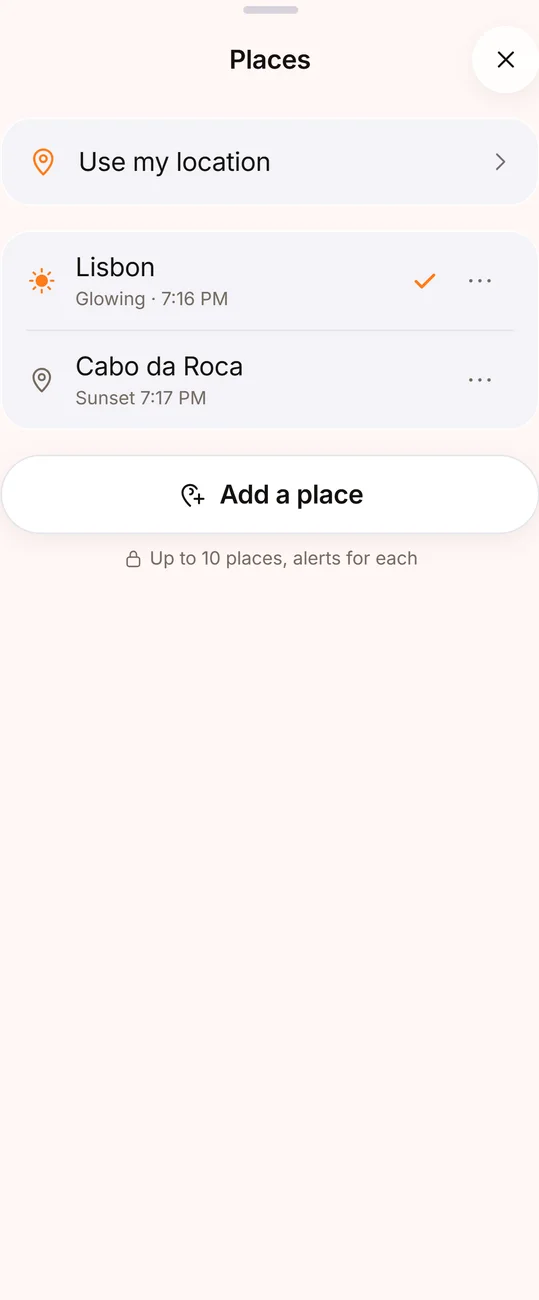 3-Day Sunset Outlook and Saved PlacesThree days of sunsets and sunrises as ranges, and up to 10 saved places with alerts.What Makes a Good Sunset? Clouds, Air and LightThe three ingredients of a colorful sunset, and the weather that ruins each one.Sunset Quality ForecastWhat a sunset score is built from, how far ahead it can be trusted, and what to look for.
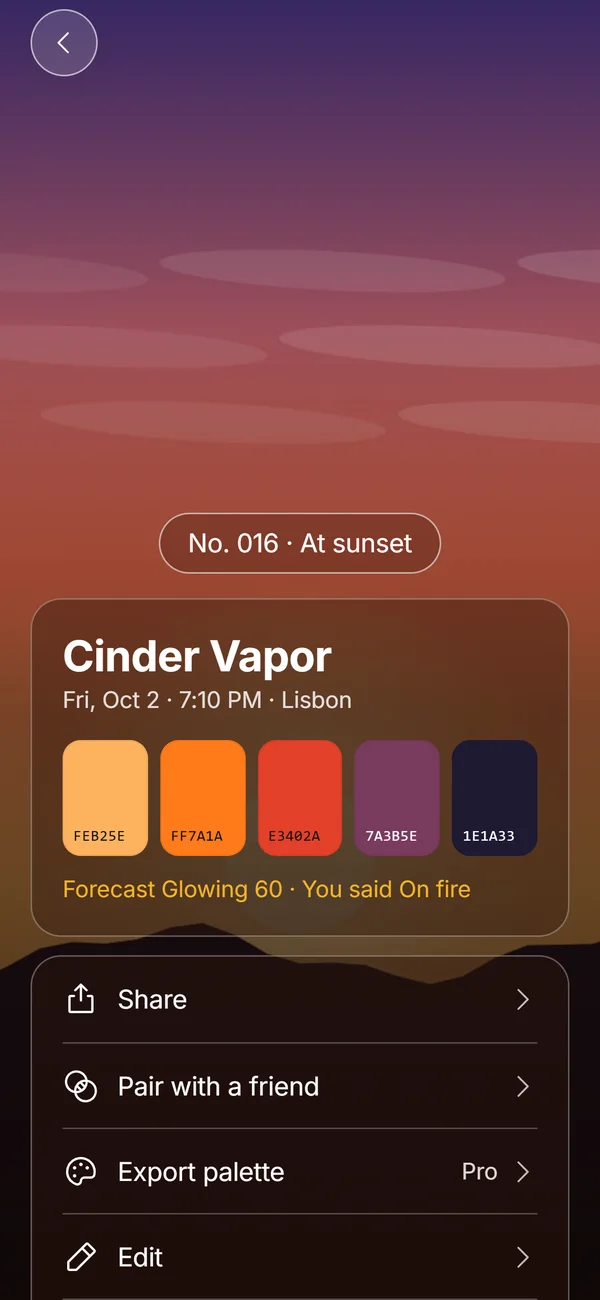 Hue ChipsFive colors, a name, a number and your rating from one sunset photo, made on the device.Does Rain Make Better Sunsets? Clearing Storms ExplainedWhen a sunset after rain is vivid, when it is flat, and the signs to look for.Does Wildfire Smoke Make Sunsets Redder?Why smoke reddens the sun, when it helps a sunset and when it flattens it, and a safety note.