 Afterhue
Does wildfire smoke make sunsets redder?
Yes. Smoke adds particles that scatter blue light out of the beam, so the low sun turns deep red or orange and looks dim. The sky can still look muddy, since thick smoke also washes out detail. Check your local air quality before you go out to watch, because a red sunset is not worth breathing smoke.
Coming soon to iPhone
Why does smoke turn the sun red?
A sunset is red because the low sun shines through a long path of air that strips out blue and green. Smoke makes that path even more effective. Wikipedia explains that sunlight reddened by the atmosphere is then scattered by cloud droplets and other relatively large particles, and that sunsets are typically more brilliant than sunrises because evening air carries more particles (Wikipedia: Sunset).
Smoke particles are about the size of visible wavelengths, so they scatter blue light strongly out of the direct beam. What is left reaches you orange or red, and often dim enough to look at without squinting.
Does a red sun mean a good sunset?
Not always. Smoke makes the sun itself dramatic, but it can also lay a flat haze across the whole sky. The colors you get are heavy reds and browns rather than layered pinks and violets, and the clouds, if there are any, may be invisible. Photographs often show a small orange ball and an almost featureless sky.
Our guide to what makes a good sunset explains why clean air with scattered high clouds usually beats a smoky evening for variety of color.
How does smoke compare with other particles?
| Cause | What it does to the sunset | Typical look |
|---|---|---|
| Clean, dry air | Little scattering of the red light | Bright, saturated colors |
| Humid or hazy air | Dulls and mutes colors | Soft, pale tones |
| Smoke | Strong blue removal, dims the sun | Deep red or orange disc, flat sky |
| Dust | Similar reddening, often with yellow | Brown to orange glow |
| Volcanic aerosol | High-altitude layers can color the whole sky | Long-lasting vivid twilight |
Why does the sky look dull when the sun is red?
Thick smoke acts like a filter in front of the whole scene. It dims the sun, softens shadows and reduces contrast, so the sky shows fewer of the layered bands that make a clear-air sunset so rewarding. If the smoke is high and thin, color can improve. If it is low and thick, the sun may disappear into a brown wall well before it reaches the horizon.
Is it safe to go outside to watch?
Check first. Smoke carries fine particles that irritate the lungs, and the worst air can occur on the days with the most striking red skies. The US government's AirNow site shows current air quality for your area, and the National Weather Service publishes wildfire safety guidance. If the air quality is poor, enjoy the sunset through a window.
- Look up the current Air Quality Index before leaving.
- If it is high, stay indoors and shoot through a closed window.
- People with asthma, heart conditions, older adults and children should be extra careful.
- Do not rely on how clear the sky looks, since fine particles are not always visible.
Can a forecast predict a smoky sunset?
Partly. Weather models can show haze and visibility, but they are less reliable at seeing smoke plumes that drift in from distant fires. In Afterhue, the Why sheet says plainly that smoke, dust, sea fog and local terrain can surprise the Glow Score. Hazy air lowers the score, because it usually dulls colors. A smoky evening can still turn the sun red. If you see that happen, tell the app how it looked after sunset.
What does Afterhue do with hazy or smoky days?
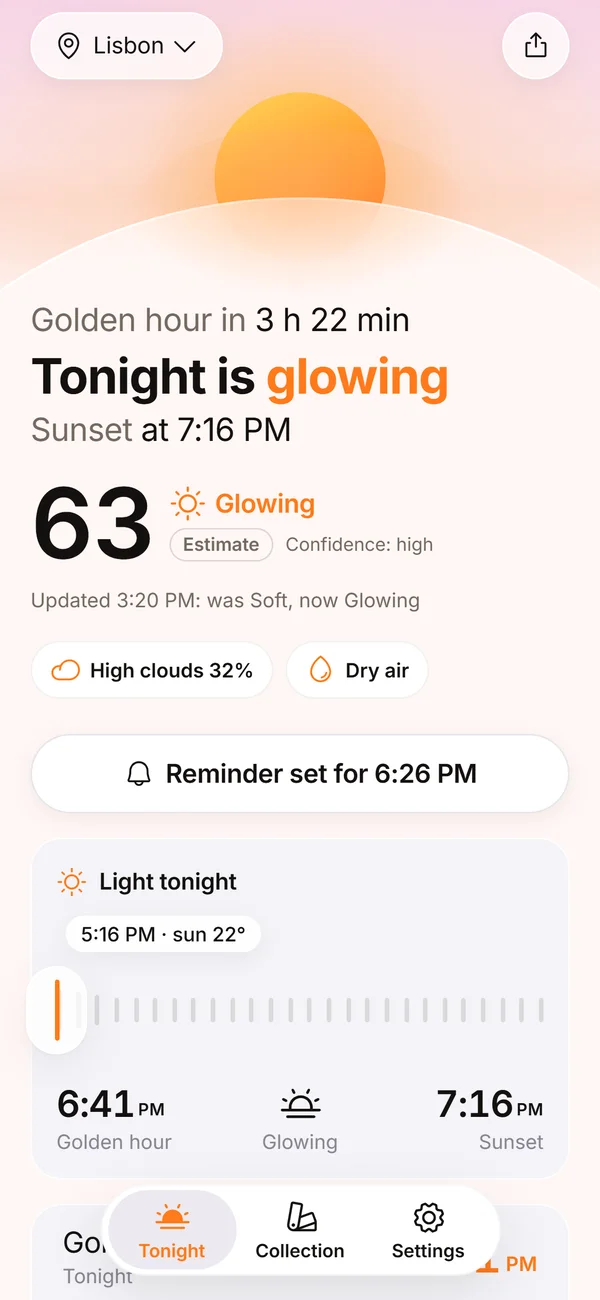
The Glow Score counts air as one of four factors. Dry air with good visibility adds to the score. Humid or hazy air takes it away, and a chip such as Hazy air tells you why. After sunset you can rate the evening with the How was it? buttons. After three ratings in an area the score shifts toward your own sky, up to 15 points either way, so repeated smoky nights teach the app how your location behaves.
How is this different from a volcanic sunset?
Volcanoes can put fine particles very high in the atmosphere, above the weather, where they stay for months. The result is a vivid twilight that can return night after night, sometimes with colors that reach high overhead long after the sun has set. Wildfire smoke sits lower, in the same layers as the weather, and changes from day to day as the wind moves it. That is why a smoky sunset can be intense one evening and nearly gone the next.
Our guide to why sunsets are red includes the history of famous volcanic skies.
What should I look for if I want color and not just a red disc?
Look for gaps. If the smoke is a thin, high veil with open sky on the western horizon, the clouds that are present can still catch color from below, and you get both the red sun and a lit sky. If the smoke is thick and low, there will be no layers to light. A few minutes of watching tells you which kind of evening it is.
- Can you see blue sky at the zenith, or is the whole sky brown?
- Is the horizon sharp, or does it vanish into haze?
- Are there any clouds above the smoke layer?
- Does the sun disc keep its edge as it sinks?
How do I photograph a smoky sunset?
The sun is dim enough to shoot directly, which is a rare chance. Tap the sun, then lower the exposure so the disc keeps its shape and color instead of burning out. A longer lens, if your phone has one, makes the sun look larger against a skyline. Add a foreground silhouette such as trees or a roof. The process is covered in the guide to photographing a sunset with an iPhone.
Is the red sky a sign of the fire nearby?
Not necessarily. Smoke can travel hundreds or even thousands of kilometers at altitude. A deep red sun in a place with no fire can come from fires in another state or country. Local news and air quality maps tell you where the smoke is coming from, and the sky color alone does not.
Frequently asked questions
Does wildfire smoke make sunsets redder?
Yes. Smoke particles scatter blue light out of the beam, so the low sun looks deeper red or orange, often dim enough to look at.
Why is the sun red when there is smoke?
The smoke removes more of the blue and green light than clean air, leaving mostly orange and red light to reach your eye.
Are smoky sunsets good for photos?
The sun itself can be striking, but the sky is often flat and brown. Silhouettes and foregrounds help.
Is it safe to watch a sunset in smoke?
Check the Air Quality Index first. If it is high, stay indoors and watch through a window.
Can Afterhue predict a smoky sunset?
Not reliably. It estimates color from clouds, air and rain, and it states that smoke and dust can surprise the score.
Keep exploring
 Sunset Glow Score0 to 100, four bands, up to three reasons, and a score that learns from your ratings.Sunset Quality ForecastWhat a sunset score is built from, how far ahead it can be trusted, and what to look for.