 Afterhue
Why are sunsets red?
Sunsets are red because the low sun's light crosses a long stretch of atmosphere, and air molecules scatter blue and green light out of the beam. What reaches your eyes is mostly orange and red. Clouds then catch that light and spread it across the sky.
Coming soon to iPhone
Why is the sky blue by day and red at sunset?
Both come from the same effect. Rayleigh scattering is the scattering of light by particles much smaller than its wavelength, such as air molecules, and it is strongly wavelength dependent: the amount of scattering is inversely proportional to the fourth power of the wavelength (Wikipedia: Rayleigh scattering). Blue light is scattered much more than red.
By day, you see the scattered blue light coming from all over the sky. At twilight, the sunlight reaching you from the low sun is missing the scattered blue wavelengths and has a yellowish to reddish hue (same source).
How much more is blue scattered than red?
Take blue at about 450 nanometers and red at about 700. The ratio of wavelengths is about 1.56, and raised to the fourth power that is about 5.9. So air scatters roughly six times more blue than red light per unit of path. At noon the path is short, and enough blue gets scattered into the sky to make it look blue while the sun stays near white.
At sunset the path through the atmosphere is far longer. Wikipedia describes it this way: the blue and green components are removed almost completely, leaving the longer-wavelength orange and red hues (Wikipedia: Sunset).
Same sunlight, longer path. The blue is spent on the way.
Why do clouds glow pink and orange?
Clouds are made of droplets or ice crystals much larger than air molecules. They scatter by a different mechanism, Mie scattering, which applies to particles comparable to or larger than the wavelength of light and is not strongly wavelength dependent (Wikipedia: Sunset). That means a cloud scatters the reddened sunlight it receives without changing its color, so it simply glows with whatever light reaches it.
This is why clouds are the difference between a nice gradient and a show. The reddened light has been traveling along the horizon all along, and the clouds are the screen. See what makes a good sunset for which clouds work best.
| Type | Particle size | What it does |
|---|---|---|
| Rayleigh scattering | Much smaller than the wavelength | Scatters blue far more than red; makes the sky blue and the low sun red |
| Mie scattering | About the wavelength or larger | Scatters all colors similarly; makes clouds and the white halo around the sun |
Why are some sunsets redder than others?
Particles in the air change the story. Wikipedia notes that sunset colors are typically more brilliant than sunrise colors because the evening air contains more particles than morning air (Wikipedia: Sunset). Dust, smoke and haze add scattering and absorption along the path.
The most famous case is Krakatoa. After the 1883 eruption, an enormous amount of fine dust blown to great height and spread worldwide by high-altitude winds produced a remarkable series of red sunsets across the planet (Wikipedia: Afterglow).
What is the purple glow after the sun is gone?
It is called the afterglow, a broad arch of whitish or pinkish light in the twilight sky after sunset. The purple light mainly occurs when the sun is 2 to 6 degrees below the horizon, during civil twilight, and it mixes the reddish light that is still scattered through the air with the blue of the twilight sky (Wikipedia: Afterglow).
If you leave when the sun drops out of sight, you can miss it. The same page notes that blue then dominates in the blue hour, which photographers and painters prize as much as the golden one. Our guide to golden hour and blue hour covers the timing.
Who figured this out?
The explanation took centuries. Around 1506 to 1510, Leonardo da Vinci conjectured that scattering of sunlight by small particles in the atmosphere gave the sky its blue hue. In 1869, John Tyndall found that bright light scattering off tiny particles was faintly blue-tinted but could not explain the preference for blue. In 1871, Lord Rayleigh published papers on the color and polarization of skylight, and the effect now carries his name (Wikipedia: Rayleigh scattering).
What does this mean for planning a sunset?
The sun reliably provides the red light. What changes from evening to evening is the canvas and the air. That is exactly what the Afterhue Glow Score estimates: clouds at high and mid levels, low cloud to the west, dryness and visibility. Afterhue gives each of those as a reason next to the score, and you can keep the results as color chips in your sky log.
What is the green flash?
Sometimes, just before sunrise or just after sunset, a brief green flash can be seen (Wikipedia: Sunset). It is rare and short, and it belongs to the same story of how the atmosphere bends and filters the sun's light near the horizon.
Are sunsets red on other planets?
Not always. Sunsets on other worlds depend on distance from the sun and the makeup of the atmosphere. On Mars the setting sun appears about two-thirds the size it does from Earth, and the colors are typically hues of blue (Wikipedia: Sunset). On the Moon, which has no atmosphere, the change from light to dark is less noticeable. The red sunsets we know are a feature of Earth's air.
How can I see the colors of a sunset in a photo?
A photo flattens the sky into pixels, and pulling out the dominant colors shows how the light is layered. In many sunset photos, the palette runs from cool tones high in the sky to warm ones at the horizon. Afterhue's Hue Chips do exactly that: five colors, ordered from the top of the sky to the horizon, with hex codes you can copy.
Frequently asked questions
Why are sunsets red and orange?
The low sun's light passes through a long path of atmosphere, and air scatters blue and green light out of it. Mostly orange and red is left.
Why are sunsets redder than sunrises?
Typically evening air holds more particles than morning air, which makes sunset colors more brilliant.
What is Rayleigh scattering?
Scattering of light by particles much smaller than its wavelength, such as air molecules. It is inversely proportional to the fourth power of the wavelength, so blue scatters much more than red.
Why do clouds turn pink at sunset?
They scatter the reddened sunlight that reaches them, a process called Mie scattering that is not strongly wavelength dependent.
Can volcanoes make sunsets redder?
Yes. After the 1883 Krakatoa eruption, fine dust in the high atmosphere produced red sunsets worldwide.
Keep exploring
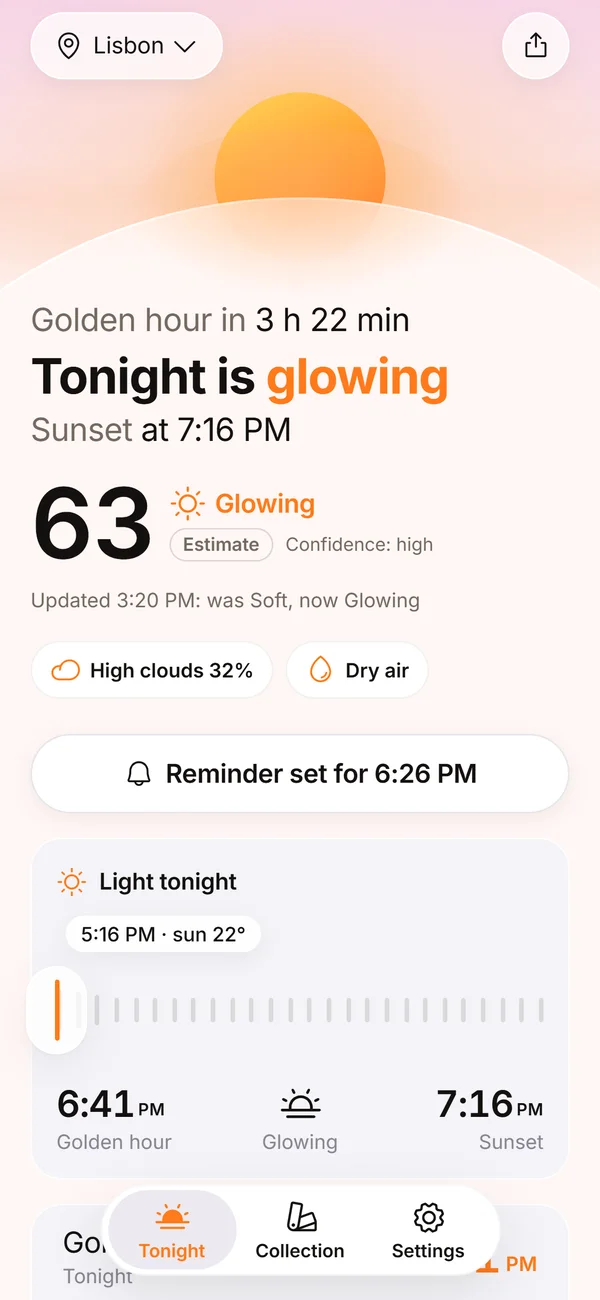 Sunset Glow Score0 to 100, four bands, up to three reasons, and a score that learns from your ratings.Sunset Quality ForecastWhat a sunset score is built from, how far ahead it can be trusted, and what to look for.
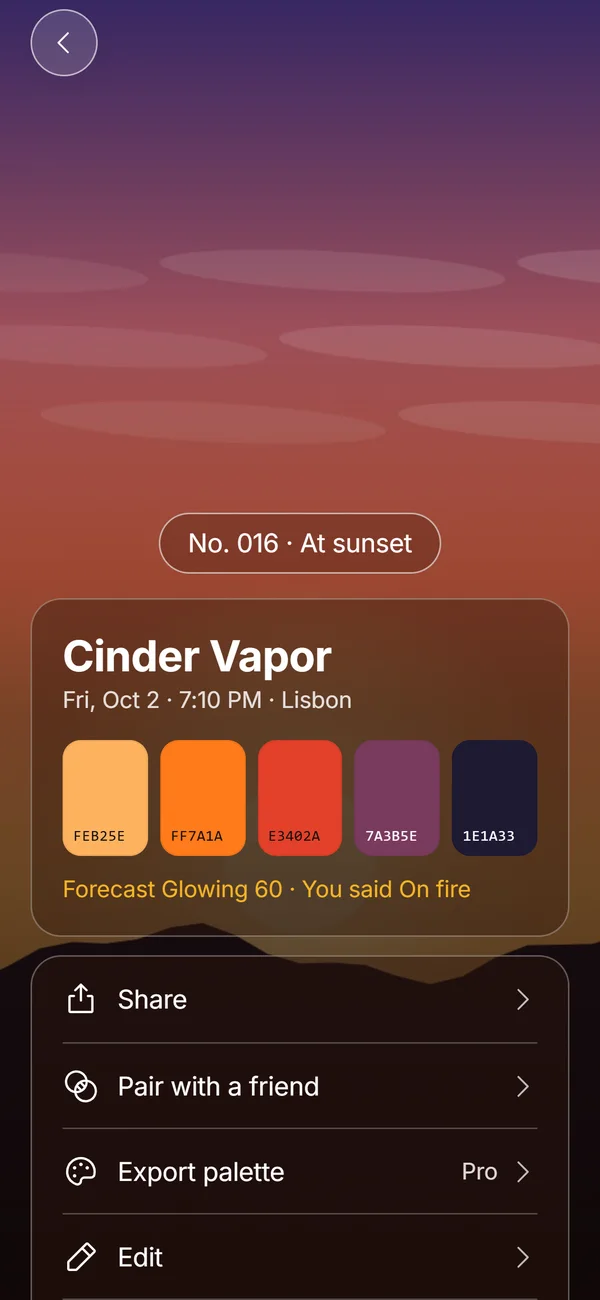 Hue ChipsFive colors, a name, a number and your rating from one sunset photo, made on the device.