 Afterhue
How a sunset quality forecast works
A sunset quality forecast takes weather model data for the hour of sunset, mainly clouds at different heights, humidity and visibility, and turns it into a score. It works best within a day. Smoke, dust, sea fog and terrain can still beat it, so a good one shows its reasons.
Coming soon to iPhone
What is a sunset quality forecast?
It is an estimate of how colorful the sky will be at sunset, usually expressed as a score or a band. People search for it as sunset quality tonight, sunset quality forecast or sunset quality tomorrow. The idea is simple. You cannot see tonight's clouds yet, but a weather model has a forecast for them, and clouds are the main thing that decides the show.
No forecast can see the actual sky. It can only say whether the ingredients look right.
What data does a sunset score use?
The most useful input is cloud cover split by altitude. Apple WeatherKit, for example, reports hourly cloud cover for low, medium and high layers, with the layers defined by height: low below 1.8 km, medium from 1.8 to 6.3 km, and high above 6.3 km (Apple: HourWeather). That matters because high cloud catches color, while low cloud blocks it.
Cloud cover itself is measured as the fraction of the sky obscured, traditionally in eighths called oktas (Wikipedia: Cloud cover). On top of cloud layers, a score can use humidity, visibility, chance of precipitation and recent rain.
- High and mid cloud: the canvas
- Low cloud, especially toward the sunset: the blocker
- Humidity and visibility: how clean the air is
- Rain that clears shortly before sunset
Why look toward the sunset and not only overhead?
Sunlight reaches the clouds from the horizon. A clear sky above you can still produce a dull evening if a low bank of cloud sits on the western horizon and blocks the light. A good model samples a second point along the direction of the setting sun. Afterhue does this at about 150 km toward the sunset, in addition to your own location.
How far ahead can a sunset forecast be trusted?
Closest to the evening, it is most dependable. Further out, less so. Cloud forecasts shift as models update, and a call of great for two days from now can slide to poor by tomorrow. That is not a bug in one app. It comes from how weather prediction works.
Afterhue deals with this by showing days beyond tonight as ranges with a confidence level, for example Glowing 52-68, and by telling you when the band changes: Updated 3:20 PM, was Soft, now Glowing.
| Lead time | What to expect |
|---|---|
| Same evening | Most reliable. Check again in the afternoon. |
| Tomorrow | A fair guide. Treat it as a range. |
| 2 to 3 days | Planning only. Expect change. |
What can a forecast not see?
Several things sit outside a standard weather model. Wildfire smoke and dust can turn a sunset deep red or mute it completely. Sea fog can roll in on the last hour. Mountains and buildings can hide the sun earlier than the calculated sunset time. Local showers can appear between model grid points.
High cirrus is a classic example of a sign that changes meaning. Cirrus are a sign that rain may be on the way (Wikipedia: Cirrus cloud), which can mean a great canvas tonight and a grey sky tomorrow.
What should a trustworthy score show?
A number alone is hard to judge. If an app says 85 and the sky is overcast, you have no way to learn why. These traits make a score easier to trust:
- The reasons, written in plain words, so you can disagree.
- An honest label that it is an estimate.
- A confidence level, and ranges for later days.
- A visible record of how often it was right.
- A clear note when the forecast changed and why.
How does Afterhue handle accuracy?
The Glow Score runs from 0 to 100 in four bands. It shows up to three reasons, a confidence level and the word Estimate on the screen. After sunset you can rate the sky with one tap. After three ratings in an area, the score shifts toward your own results, by at most 15 points, and the app shows a tally such as 6 right, 3 close, 1 off.
Afterhue does not publish an accuracy percentage, because it has not been released and has no measured results yet. The weather data comes from Apple WeatherKit, and sun times are computed on the device.
What is the practical way to use a forecast?
Use it to decide whether to bother, and use your eyes to decide where to stand. Check the score in the afternoon, look west an hour before sunset, and go if both agree. Set a golden-hour reminder so you do not forget, and read what makes a good sunset to learn to second-guess the number.
What should I do with a Soft score?
Soft means some warm light and gentle color. It does not mean skip it. A soft evening is a fine one for a walk and the golden-hour light is still there. A Flat score, 0 to 24, says little color is expected, so you might save the trip. Glowing and On fire, 50 and above, are the ones where a short drive for a better viewpoint is worth considering.
Is a sunrise forecast the same thing?
It uses the same ingredients, high and mid cloud, a clear gap toward the sun, clean air, evaluated at sunrise instead. Wikipedia notes that sunset colors are typically more brilliant than sunrise colors, because evening air has more particles (Wikipedia: Sunset), so do not expect the same ceiling. Afterhue offers sunrise forecasts and alerts in Pro.
How do I build my own sense of it?
Rate the evenings. Afterhue asks How was it? 30 minutes after sunset if you turn that prompt on, and the four answers, Flat, Soft, Glowing and On fire, are compared with the prediction an hour before sunset. Over a few weeks the score moves toward what your local skies actually do, and your own results are shown on the Why screen. The same ratings show on each Hue Chip.
Frequently asked questions
Is there a sunset quality calculator?
Several apps compute one from weather model data. Look for ones that show the reasons behind the number and label it as an estimate.
How accurate is a sunset forecast?
It is most reliable on the same evening and less so for later days. Smoke, dust, fog and terrain can change the result.
Can I check sunset quality for tomorrow?
Yes. Treat it as a range. Afterhue shows tomorrow's band for free and the full 3-day outlook in Pro.
What data does Afterhue use?
Cloud layers, humidity, visibility and rain chances from Apple WeatherKit at your place and about 150 km toward the sunset. Sun times are calculated on the iPhone.
Why did a high score turn out grey?
Models can miss low cloud, smoke, fog and local terrain. Rating the evening teaches the app how your sky behaves.
Keep exploring
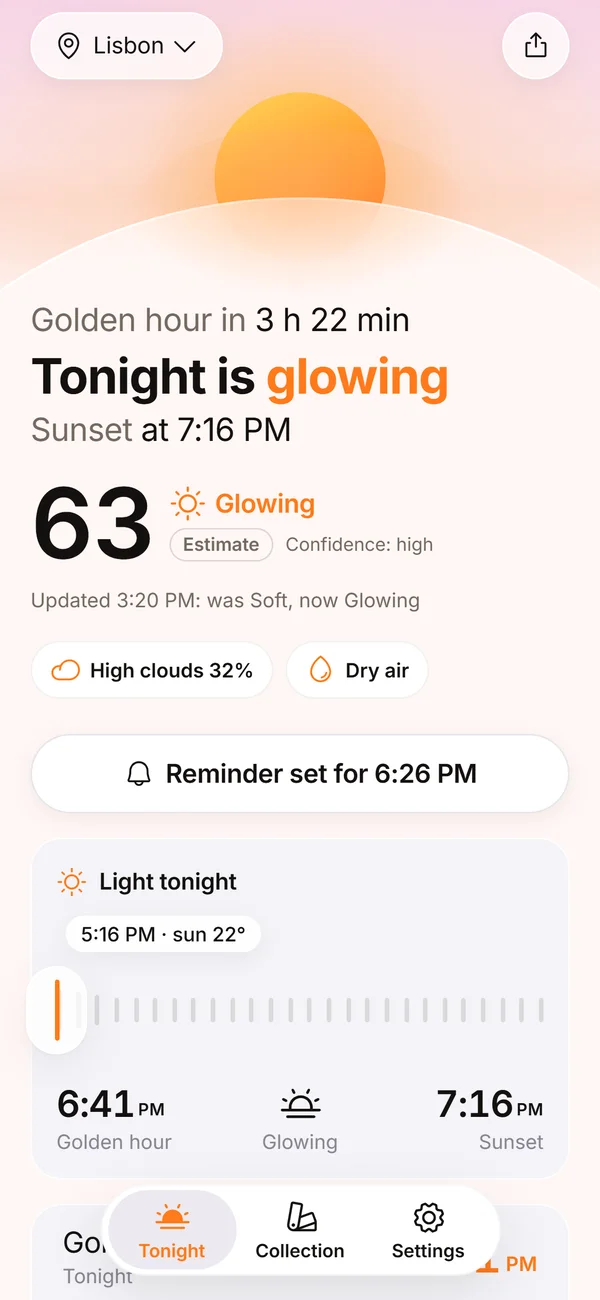 Sunset Glow Score0 to 100, four bands, up to three reasons, and a score that learns from your ratings.
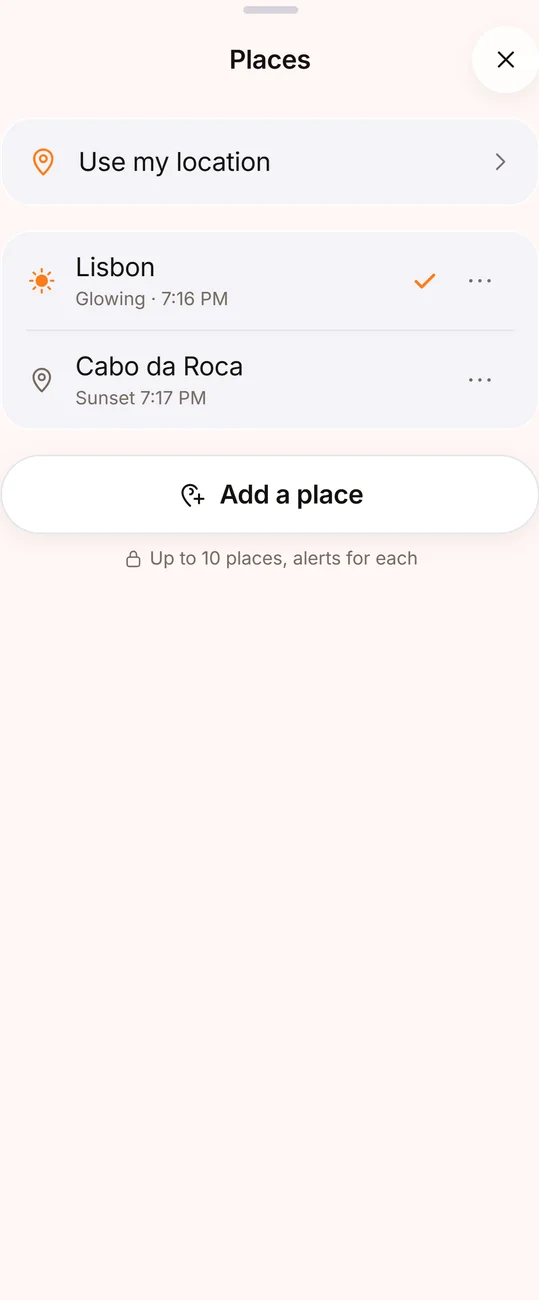 3-Day Sunset Outlook and Saved PlacesThree days of sunsets and sunrises as ranges, and up to 10 saved places with alerts.What Makes a Good Sunset? Clouds, Air and LightThe three ingredients of a colorful sunset, and the weather that ruins each one.What Is Golden Hour? Times, Light and Blue HourWhat golden hour is, why the light looks gold, how long it lasts and how it differs from blue hour.
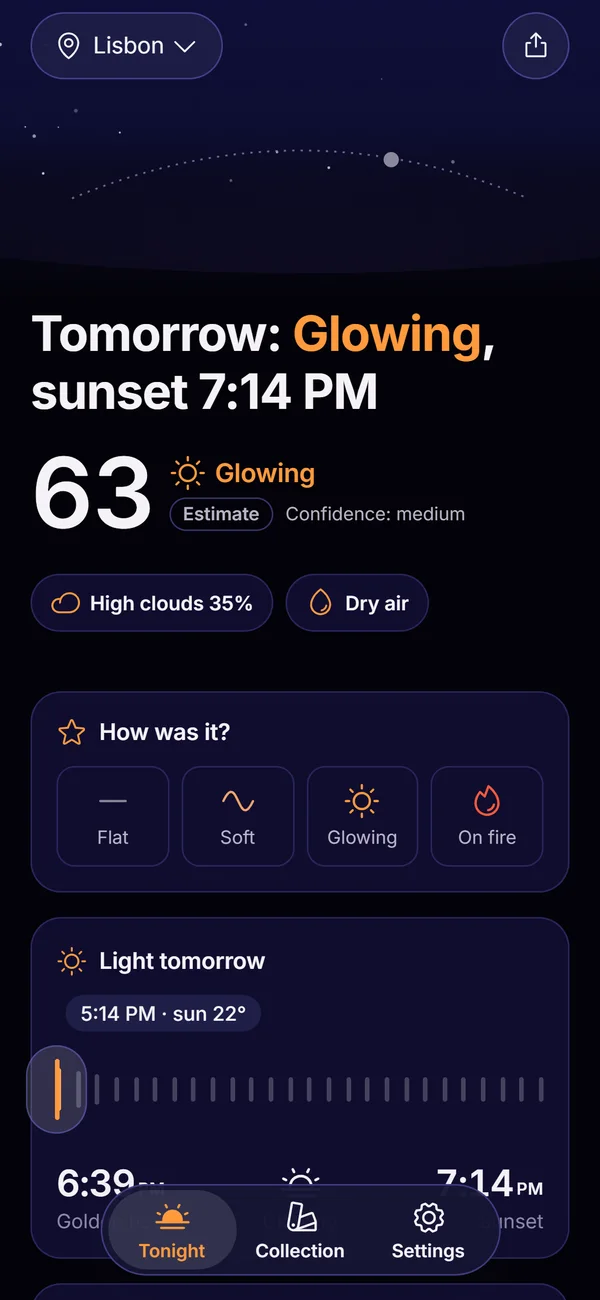 Golden Hour Alerts and Reminders for SunsetsA free daily golden-hour reminder, plus Pro alerts only for evenings above your threshold.