 Afterhue
What is golden hour?
Golden hour is the period shortly after sunrise or before sunset when daylight is redder and softer than it is with the sun high in the sky. It has no fixed length: it depends on your latitude and the season. Blue hour is the cooler stretch just before sunrise and after sunset.
Coming soon to iPhone
What does golden hour mean?
In photography, golden hour is the period of daytime shortly after sunrise or before sunset during which daylight is redder and softer than when the sun is higher in the sky. Cinematographers and photographers also call it magic hour (Wikipedia: Golden hour (photography)).
The word hour is figurative. The effect has no clearly defined duration and varies with the season and your latitude.
Why does the light look golden?
With the sun low, its rays pass through more atmosphere. That cuts the intensity of the direct light, so more of the illumination comes from the sky instead, which lowers contrast. More blue light is scattered away, so the sun itself looks redder. The low angle also stretches shadows (Wikipedia: Golden hour (photography)).
For photographers, the result is gentler shadows and highlights that are less likely to blow out than in the harsh light of midday. For everyone else, it is simply nicer to stand in.
How long does golden hour last?
It depends on how fast the sun climbs or sinks, which depends on latitude and time of year. Wikipedia gives an example: in Los Angeles, an hour after sunrise or an hour before sunset the sun is about 10 to 12 degrees above the horizon. Closer to the equator, the same altitude is reached in less than an hour. Farther from it, the altitude takes more than an hour, and at high enough latitudes the sun may never reach 10 degrees, so the golden hour can last for the entire day in some seasons (Wikipedia: Golden hour (photography)).
| Where you are | Golden hour tends to be |
|---|---|
| Near the equator | Short, because the sun moves steeply |
| Mid-latitudes | Around an hour, longer near the solstices |
| High latitudes | Long and slow, sometimes all day in some seasons |
What is blue hour?
Blue hour is the period just before the golden hour at sunrise, or just after it at sunset, when the sun is well below the horizon. Residual indirect sunlight takes on a predominantly blue shade and there are no sharp shadows (Wikipedia: Golden hour (photography)). It belongs to twilight, which Wikipedia divides into civil, nautical and astronomical stages.
Civil twilight begins when the sun disappears below the horizon and ends at 6 degrees below. Nautical twilight runs from 6 to 12 degrees below, and astronomical twilight from 12 to 18 degrees (Wikipedia: Sunset).
How does Afterhue define golden hour?
Because the term is loose, a reminder app has to pick numbers. Afterhue defines golden hour as the sun between 6 degrees above the horizon and 4 degrees below it, and blue hour as 4 to 6 degrees below. Sunset is the moment the sun's upper edge meets the horizon, which the app calculates as the sun's center about 0.83 degrees below it. All of this is computed on the iPhone from the date and your position, so it works offline.
These are the app's own choices, not an industry standard. Other apps and photographers draw the line elsewhere, so times can differ by several minutes.
| Phase | Sun altitude in Afterhue |
|---|---|
| Golden hour | From +6 degrees down to -4 degrees |
| Sunset | About -0.83 degrees (upper edge on the horizon) |
| Blue hour | From -4 degrees to -6 degrees |
| Civil dusk | -6 degrees |
How many minutes is golden hour where I live?
About 40 minutes at the equator and well over an hour at high latitudes. On an equinox the sun's height changes by roughly 15 degrees an hour times the cosine of your latitude, so the farther you are from the equator, the slower it sinks and the longer the light stays low. At 45 degrees that is about 10.6 degrees an hour, which puts the last 10 degrees of daylight at close to an hour.
The table applies Afterhue's window, the sun from 6 degrees above the horizon to 4 below, with standard solar-position math. The figures are my own calculation, rounded to the nearest five minutes, and ignore weather and terrain.
| Latitude | Near | Equinox | Solstice |
|---|---|---|---|
| 0 | Quito | 40 min | 45 min |
| 35 | Tokyo | 50 min | 55 min |
| 45 | Milan | 55 min | 70 min |
| 52 | Berlin | 65 min | 85 min |
| 60 | Oslo | 80 min | 130 min |
Why is golden hour shortest at the equinoxes?
Near a solstice the sun meets the horizon at a shallower angle, so it takes longer to cross the same few degrees of height. Near an equinox its path is steepest, which makes the window shortest. A flat one-hour rule is about right at 45 degrees in spring and autumn, and too short at 60 degrees around midsummer or midwinter.
What does an evening look like, minute by minute?
Picture a sunset at 7:00 PM at 45 degrees north on an equinox. With the same calculation as above, the evening runs as follows.
- About 6:20 PM: golden hour begins, with the sun 6 degrees above the horizon.
- 7:00 PM: sunset, the moment the upper edge of the sun meets the horizon.
- About 7:18 PM: golden hour ends in Afterhue, with the sun 4 degrees below the horizon.
- About 7:29 PM: blue hour and civil twilight end, with the sun 6 degrees below.
How does that sequence change with latitude?
Golden hour has a front of about 40 minutes and a tail of about 18, and blue hour is short, roughly 11 minutes. Wikipedia places the purple light of the afterglow at 2 to 6 degrees below the horizon (Wikipedia: Afterglow), which falls inside that last half hour. Closer to the equator the sequence runs faster, and at 60 degrees it is slower: the tail between sunset and the end of golden hour grows from about 13 minutes at the equator to about 25.
Which mistakes make people miss it?
Three come up often.
- Trusting one app's definition. Wikipedia's Los Angeles example has the sun 10 to 12 degrees up an hour before sunset. Start the clock at 10 degrees instead of 6 and, at 45 degrees on an equinox, golden hour begins about 20 minutes earlier. Two apps can both be right and still disagree.
- Forgetting that the sun moves along the horizon. In the Northern Hemisphere the sun sets to the northwest in spring and summer and to the southwest in autumn and winter (Wikipedia: Sunset). A viewpoint that frames the sun in June may not in December.
- Standing where a ridge or building hides the sun early. The calculated sunset assumes a flat horizon. Behind a hill the direct light can vanish many minutes sooner while the sky above is still lit.
How do I plan for golden hour?
Know the time, arrive early, and stay late. A reminder helps, because the start of golden hour moves a minute or two each day.
- Find tonight's golden-hour start and sunset time for your exact place.
- Set a reminder 15 to 30 minutes before the start so you can walk to your spot.
- Scout the western horizon for anything that blocks the sun, such as buildings and hills.
- Stay through sunset and into blue hour, because the sky often changes after the sun is gone.
- If the sky is promising, check how the score and reasons look before you commit to a long trip.
Does a golden hour always give a colorful sky?
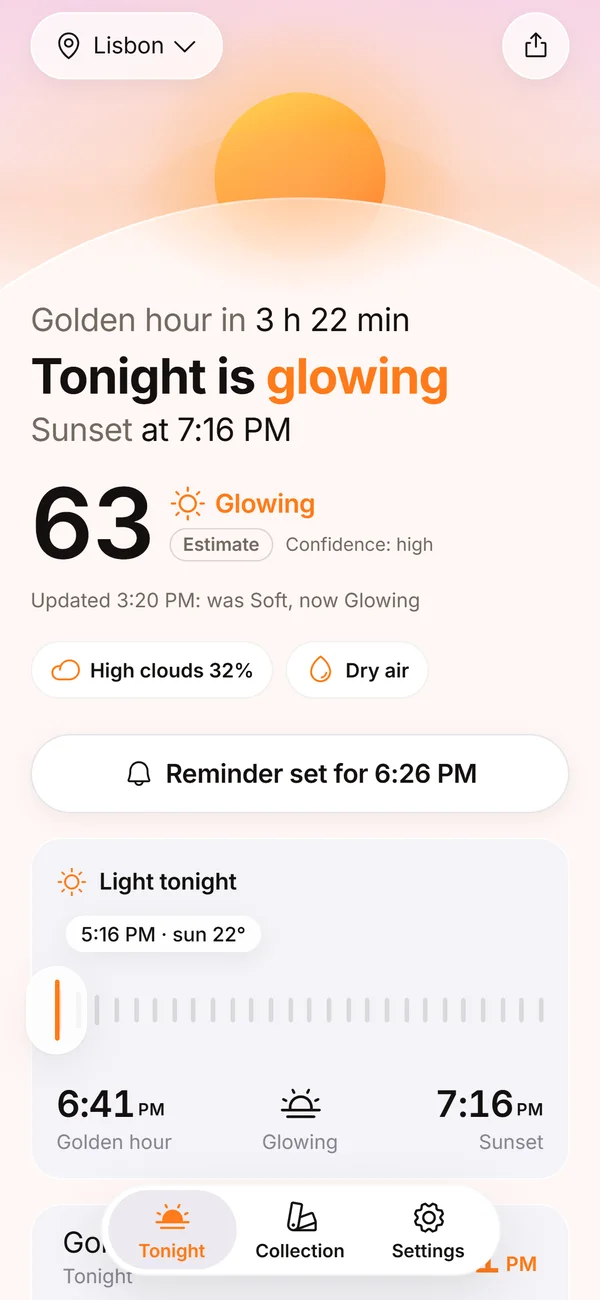
No. Golden hour describes the angle of the sun, not the clouds. Warm, soft light happens on clear evenings too. Whether the sky itself burns orange and pink depends on clouds and air, which is the subject of our guide to what makes a good sunset. The golden-hour reminder in Afterhue is free, and the sunset score tells you whether the sky is likely to join in.
Is there a golden hour at sunrise too?
Yes. The same low-sun light happens in the morning, and the same naming applies. Afterhue's default reminder follows the evening, but the Pro alerts can also cover sunrise. Meteorologists even have a word for the pink arch that appears before sunrise, the foreglow, which is the morning counterpart of the afterglow (Wikipedia: Afterglow).
Why do photographers like it so much?
Midday sun creates strong highlights and dark shadows, and a camera has a limited dynamic range, so overexposure is more likely. In portraits the problem is worse, and a fill flash is often needed to balance the face. In the golden hour contrast is lower, shadows are less dark, and highlights are less likely to be overexposed (Wikipedia: Golden hour (photography)).
What happens in the polar regions?
Near the poles the sun can stay above the horizon all night or below it all day. Locations north of the Arctic Circle and south of the Antarctic Circle see no full sunset or sunrise on at least one day each year (Wikipedia: Sunset). In those cases Afterhue shows a plain message, The sun stays up all night here or The sun does not rise here today, and hides the score instead of inventing a time.
Frequently asked questions
What is golden hour?
The period shortly after sunrise or before sunset when daylight is redder and softer than with the sun high in the sky.
How long is golden hour?
There is no fixed length. It depends on latitude and season, and is often around an hour in mid-latitudes.
What is the difference between golden hour and blue hour?
Golden hour has the sun low in the sky and warm light. Blue hour comes when the sun is well below the horizon and the indirect light looks blue, with no sharp shadows.
What time is golden hour today?
It depends on your location and date. Afterhue computes it on the device for your place and can remind you before it starts.
Is golden hour the same as sunset?
No. Golden hour is the stretch of warm light before sunset. Sunset is the moment the sun's upper edge disappears below the horizon.
How many minutes before sunset does golden hour start?
By Afterhue's definition, about 40 minutes at 45 degrees latitude on an equinox, closer to 30 at the equator and about 55 at 60 degrees. The gap is longer near the solstices.
Keep exploring
 3-Day Sunset Outlook and Saved PlacesThree days of sunsets and sunrises as ranges, and up to 10 saved places with alerts.
 Sunset Glow Score0 to 100, four bands, up to three reasons, and a score that learns from your ratings.Why Is the Earliest Sunset Before the Winter Solstice?Why the earliest sunset falls before the solstice and the latest sunrise after it, with approximate dates.