 Afterhue
What makes a good sunset?
A good sunset needs three things at once: thin clouds high up to catch the light, a clear gap near the western horizon so the light can reach them, and air clean enough that the colors stay saturated. Any one missing gives a pale sky, however dramatic the forecast looked.
Coming soon to iPhone
What causes a colorful sunset?
Color starts in the atmosphere, not in the clouds. When the sun is low, its light crosses a much longer stretch of air before it reaches you. Air molecules scatter blue and green light out of the beam, and what is left is orange and red (Wikipedia: Sunset). That reddened light is then scattered by cloud droplets and larger particles, which is what lights up the sky around the horizon.
So the sun supplies the red light, but you only see it spread across the sky if something is there to catch it. That something is cloud. Our guide to why sunsets are red goes deeper into the scattering.
What weather makes a good sunset?
Photographers most often describe partly cloudy skies with thin cloud high up. A perfectly clear sky gives a clean gradient from orange to blue, which is pretty and gentle. A solid grey ceiling gives almost nothing, because the red light has no surface to land on and the sun itself is hidden.
The sweet spot is a canvas of high and mid-level cloud with open sky to the west. Cirrus clouds form above 6,000 meters, are made of ice crystals, look wispy and transparent, and the rising or setting sun can color them yellow or red (Wikipedia: Cirrus cloud). Altocumulus sits lower, at roughly 2,000 to 6,100 meters, in patches and rolls (Wikipedia: Altocumulus cloud).
What conditions make a good sunset, side by side?
This table is the same logic the Afterhue Glow Score uses, written out for people.
| Factor | Helps | Hurts |
|---|---|---|
| High and mid clouds | Thin, broken, wispy | None at all (gentle color) or a thick sheet |
| Low clouds to the west | Absent or a low, thin band | A bank between you and the sun |
| Air | Dry, good visibility | Humid, hazy, fogged in |
| Rain | Rain that clears before sunset | Rain still falling at sunset |
Why do the low clouds to the west matter so much?
Because the light travels sideways. At sunset the sun's rays graze the surface and pass under the clouds overhead to light their undersides. If a low bank sits in the west, it blocks that path, and the clouds above you stay dim even though they were ideal.
This is why Afterhue does not look only at your own sky. It also reads the forecast at a point about 150 km toward the setting sun, since the light you will see comes from over there. A clear overhead sky with a wall of cloud on the horizon often means no show.
Does air quality change the colors?
Yes. Clean, dry air with good visibility keeps colors saturated. Humid or hazy air washes them out. Particles also shape what you see: Wikipedia notes that sunset colors are typically more brilliant than sunrise colors because the evening air holds more particles than the morning air (Wikipedia: Sunset).
There is an exception for very fine particles high in the atmosphere. After the 1883 eruption of Krakatoa, fine dust carried to great height produced a remarkable series of red sunsets around the world (Wikipedia: Afterglow). Smoke and dust can deepen color, and they can also mute it, so a model cannot always tell.
How do I judge tonight's sunset myself?
You can do a rough check in a minute, with or without an app.
- Look west about an hour before sunset. Note whether there is thin cloud overhead or a flat grey sheet.
- Check the western horizon for a low bank of cloud. A clear gap, even a narrow one, is what you want.
- Check how far you can see. Crisp distance means dry air.
- If rain has just ended and the sky is breaking up, stay alert. Clearing skies can go either way.
- Go out about 20 minutes before sunset and stay until the sun is well below the horizon.
Is the best color at the moment of sunset?
Often it comes after. Sunset is defined as the moment the upper edge of the sun disappears below the horizon, and refraction means the sun is already about one diameter below the horizon geometrically by then. Civil twilight runs until the sun is 6 degrees below the horizon (Wikipedia: Sunset).
The pink and purple afterglow tends to show when the sun is 2 to 6 degrees below the horizon (Wikipedia: Afterglow). That is why people who leave the moment the sun drops often miss the best part.
Stay for the first 20 to 30 minutes after sunset. That is when the afterglow can peak.
How does Afterhue use all this?
The Glow Score turns these factors into a number from 0 to 100 for tonight, shows up to three reasons, and labels itself an estimate. After sunset you can rate how it looked, and the score adjusts to your own sky over time. For forecasts that look further ahead, see how sunset quality forecasts work.
How can I tell high clouds from low clouds?
Look at texture and brightness. High cirrus clouds look like thin white strands, hair or feathers, and you can often see the sun through them. Mid-level altocumulus forms patches or rolls of small cloud elements. Low clouds are the ones that feel heavy, dark and close, and they tend to fill the horizon rather than float above it.
A practical rule: wispy and bright is good, thick and low is bad. Our score makes the same distinction automatically, by reading separate low, medium and high cloud layers from the forecast.
Why can a cloudy evening still be a dud?
Because cloud cover is only half the story. Wikipedia points out that clouds can block sunlight, especially at sunrise and sunset, when the sunlight is already limited (Wikipedia: Cloud cover). A thick overcast takes away both the sun and the light for the canvas. A sky with 70 percent cloud made of thin high layers can glow, while a sky with 90 percent low stratus will not.
Are sunrises as good as sunsets?
They can be, but on average they look weaker. The usual explanation, repeated on Wikipedia, is that evening air holds more particles than morning air, which makes sunset colors typically more brilliant than sunrise colors (Wikipedia: Sunset). Afterhue treats sunrises as their own forecast, available in Pro, with the same ingredients.
Frequently asked questions
What makes a good sunset happen?
Thin high or mid-level clouds to catch the light, a clear gap to the west, and clean dry air. The sun supplies the red light and the clouds spread it across the sky.
Do clouds make a sunset better?
Some do. Thin, broken high clouds help a lot. A clear sky gives gentle color, and a thick overcast gives almost none.
What weather makes a good sunset?
Partly cloudy weather with open sky near the western horizon and good visibility. Dry air keeps colors from washing out.
Why are some sunsets grey?
Usually a thick or low cloud layer blocks the sun, or humid, hazy air mutes the color.
How long after sunset can the sky still glow?
The afterglow is strongest while the sun is about 2 to 6 degrees below the horizon, which is during civil twilight.
Keep exploring
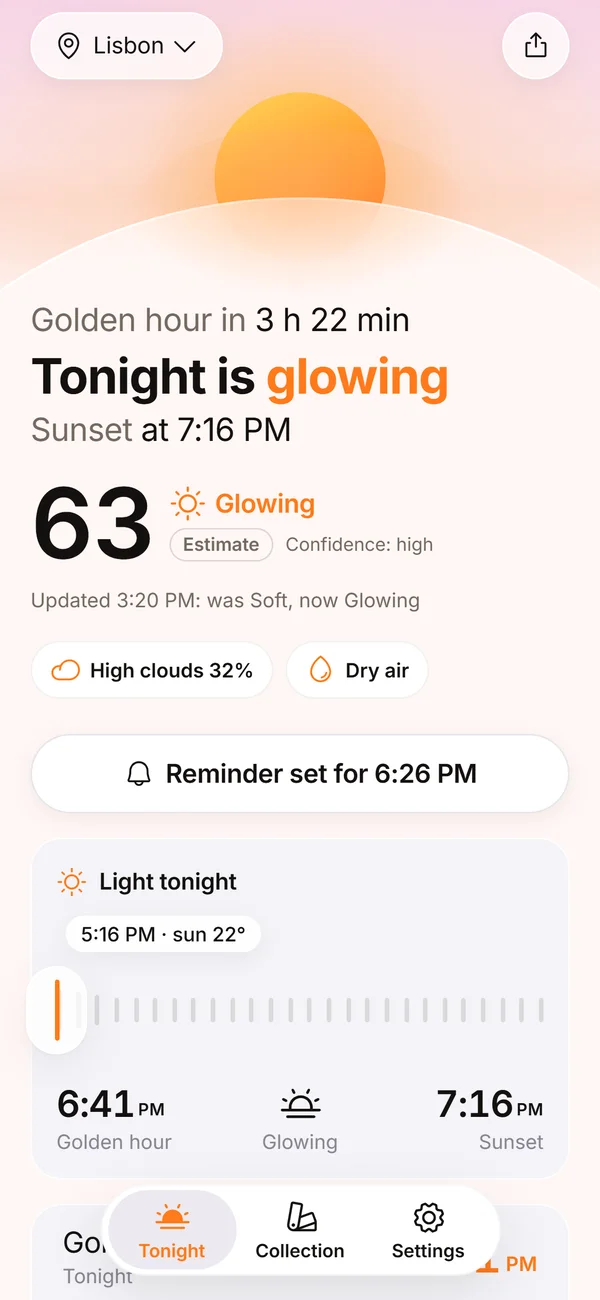 Sunset Glow Score0 to 100, four bands, up to three reasons, and a score that learns from your ratings.Why Are Sunsets Red? Scattering Explained SimplyThe physics of red sunsets in plain language: Rayleigh scattering, long paths, clouds and dust.What Is Golden Hour? Times, Light and Blue HourWhat golden hour is, why the light looks gold, how long it lasts and how it differs from blue hour.Sunset Quality ForecastWhat a sunset score is built from, how far ahead it can be trusted, and what to look for.
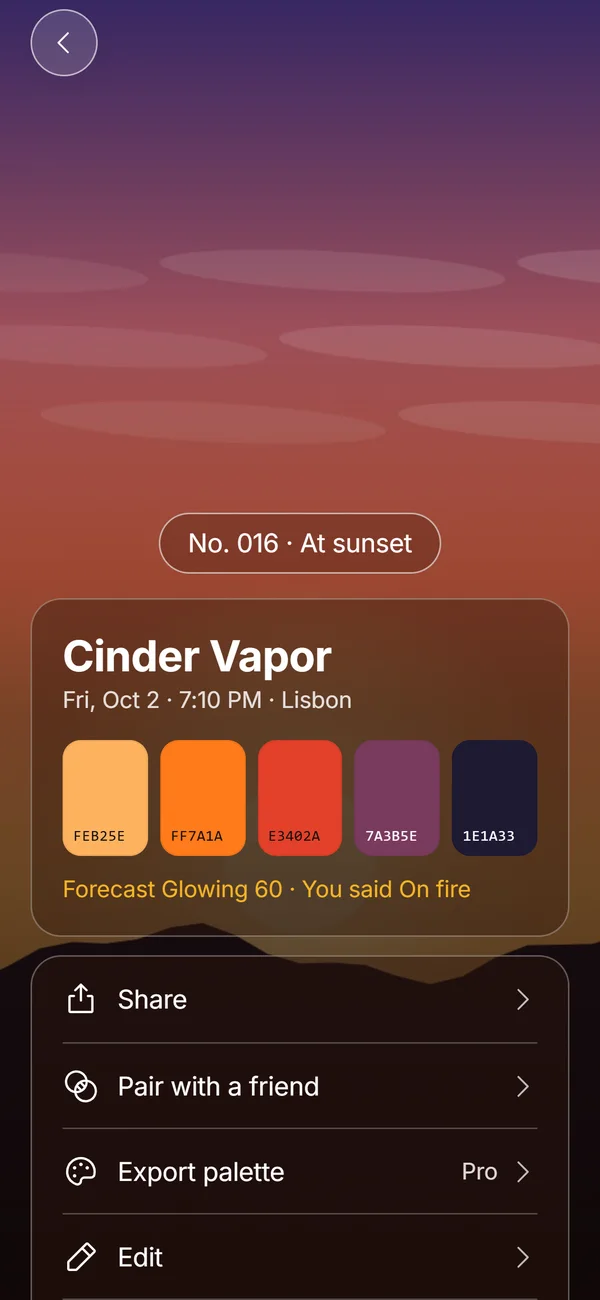 Hue ChipsFive colors, a name, a number and your rating from one sunset photo, made on the device.