 Afterhue
What is the green flash at sunset?
The green flash is a brief green spot that sometimes appears on the upper rim of the sun at the moment of sunset or sunrise, usually lasting under two seconds. It happens because the atmosphere bends colors by different amounts. You need a clear, unobstructed horizon and still air, and the ocean is the classic place.
Coming soon to iPhone
What exactly is the green flash?
It is a meteorological optical phenomenon seen around the moment of sunset or sunrise. Wikipedia describes a distinct green spot briefly visible above the sun's upper limb, with the green usually lasting no more than two seconds. Rarely it can look like a green ray shooting up from the point where the sun vanishes (Wikipedia: Green flash).
It can also appear with the moon and with bright planets such as Venus and Jupiter at the horizon.
Why does it happen?
The atmosphere acts like a weak prism. Light from the sun bends as it passes through air, and each color bends by a slightly different amount, so the images of the sun in different colors are stacked at the horizon. Blue light bends the most, but it is also scattered out of your line of sight, and what remains at the top edge of the disc ends up looking green.
Wikipedia adds that mirages enhance the effect, because they increase refraction. A flash is more likely in stable, clear air, when more of the light reaches you without being scattered.
How rare is it?
Rarer than the legend suggests, but not mythical. A green rim is present at every sunset, yet it is too thin for the naked eye to see. The flash and the ray need layered air and a mirage, which is why most people never notice one. Wikipedia says the majority of observed flashes are inferior-mirage or mock-mirage effects, and the rest account for only 1 percent of reports.
What are the main types?
| Type | What you see | Where |
|---|---|---|
| Green rim | A thin green edge on the upper limb, too faint for the naked eye | Every sunset |
| Green flash | A distinct green spot for up to about two seconds | Clear horizons, often over the sea |
| Green ray | A green beam rising from the sun point | Rare, needs layered air |
| Blue flash | Brief blue instead of green | Very rare, very clean air |
| Cloud-top flash | Flash as the sun sinks into distant clouds or fog | Not well understood |
Where and when do people see it?
Wikipedia says green flashes can be observed from any altitude, usually at an unobstructed horizon such as over the ocean, and also over cloud tops and mountain tops. They occur at any latitude. Airline pilots see them regularly, especially when flying westward and the sunset is slowed. The best time to watch for a green rim is about ten minutes before sunset, when the sun is low but still bright.
That timing creates a safety question, which the next section covers.
How can I watch for it safely?
Never stare at the sun, and never use binoculars or a telescope on it. Wikipedia points out that ten minutes before sunset is too early for magnification without potential harm to the eyes, and suggests projecting the image onto a sheet of paper. Wait until the sun is a thin sliver on the horizon, when its light has been weakened by the long path through the air. Glancing at the final sliver is a common practice, but if you feel any discomfort, look away.
- Pick a spot with a clear, flat horizon toward the sunset bearing, such as a beach.
- Look at the horizon, not the sun, until the last thin sliver.
- Watch the upper edge as the final part of the disc vanishes.
- Stay a second longer. The flash occurs right at the end.
Can I film it on an iPhone?
You can try. Use a stable surface, tap the sun to lock focus and exposure, and lower the exposure slightly so the last sliver does not burn out. A telephoto lens, if your model has one, makes the rim larger. Take a video, because a flash that lasts one or two seconds is easy to miss with a still. Then step through the video frame by frame. The general technique is the same as in our guide to photographing a sunset with an iPhone.
Why is it seen so often at sea?
The ocean gives a flat, sharp horizon with nothing in front of it, and warm or cool layers of air above the water create the mirages that magnify the green. Sailors, ferry passengers and beach walkers with a western view have had centuries of practice. Over land, trees, hills and buildings cut the last sliver of the sun before the flash can form, and city haze softens the edge even where the horizon is open.
A mountaintop or a plane window can work too, since you are looking over a distant, clear horizon.
What do people get wrong about it?
Most expect a dramatic green burst across the sky. In practice it is a tiny bright dot at the top edge of the sun for a second or two, and some people need to see it three or four times before they are sure. Others confuse it with lens flare or an afterimage from staring at the sun, which is why the safety advice matters. A real flash appears in the same place as the sun's upper rim, in the same direction, whichever way you tilt your head.
Does the green flash happen at sunrise too?
Yes. It can appear at either end of the sun's visit above the horizon. It is harder to plan for at sunrise because you do not know the exact moment the sun will break through, and the first sliver is often hidden by morning haze. The same advice holds: a clear horizon, still air, and care with your eyes.
Can a forecast predict a green flash?
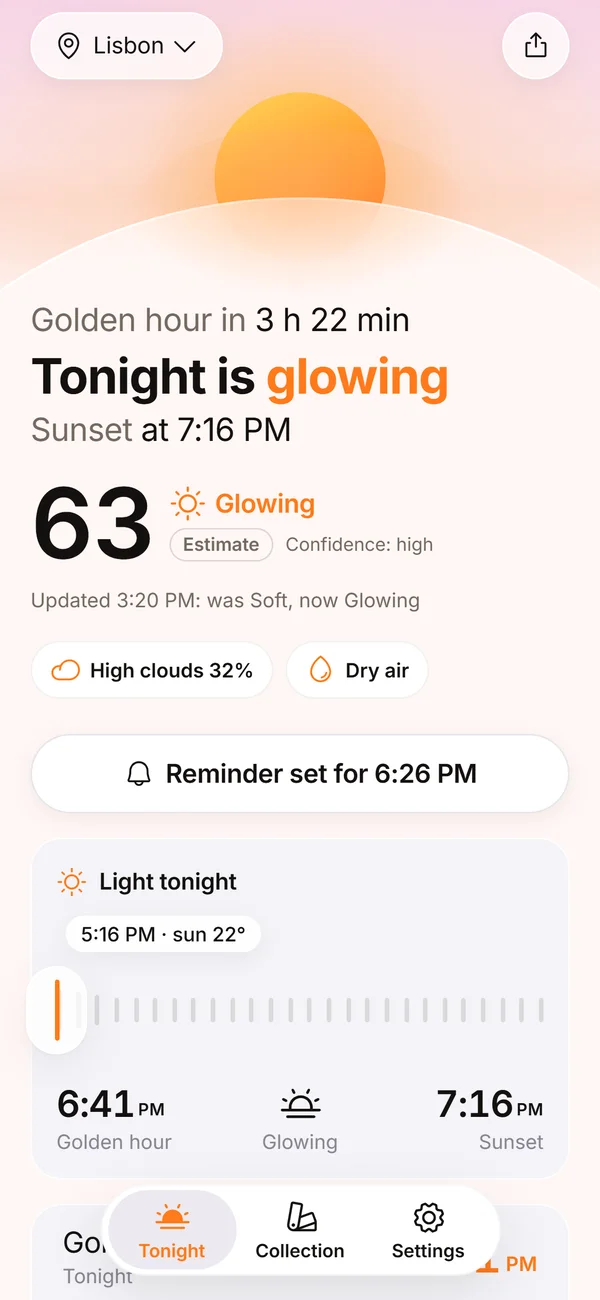
Not directly. The conditions that favor one, such as clear air to the west, a sharp horizon and a stable atmosphere, line up with what the Glow Score lists as Clear to the west and Dry air. That tells you the evening is promising for clean views, but the score does not forecast a flash. A flash is a bonus on a clear evening, while a score tells you about color.
Is there any history or culture around it?
Plenty. Wikipedia notes that the first color photograph of the green flash at sunset was made by D. J. K. O'Connell at the Vatican Observatory in 1960, and that Jules Verne's 1882 novel The Green Ray helped popularize the phenomenon. It remains a favorite for sailors and sunset watchers, and a reason to stay until the final second of the sun, as in what makes a good sunset.
Frequently asked questions
What is the green flash at sunset?
A brief green spot on the upper rim of the sun at the moment it sets or rises, caused by the atmosphere bending colors by different amounts.
How long does a green flash last?
Usually no more than about two seconds.
Where is the green flash easiest to see?
At an unobstructed horizon with clear, stable air, such as over the ocean.
Is it safe to look for the green flash?
Only look at the last thin sliver of the sun, never the full disc, and never through binoculars or a telescope. Look away if there is any discomfort.
Can an app predict a green flash?
No. Afterhue estimates sunset color from clouds, air and rain, and a clear western horizon can favor a flash, but it is not a prediction.
Keep exploring
 Sunset Glow Score0 to 100, four bands, up to three reasons, and a score that learns from your ratings.How to Photograph a Sunset With Your iPhoneA practical sunset routine for iPhone: timing, tap-and-hold exposure lock, composition and what to do after the sun sets.