 Afterhue
Why is the sky purple after sunset?
The purple after sunset is the afterglow. Once the sun is a few degrees below the horizon, only the red end of its light still reaches high air and clouds, and it mixes with the blue of the twilight sky. Your eye reads that blend as purple or violet. It is strongest on clear, clean evenings.
Coming soon to iPhone
What is the afterglow?
The afterglow is the glow that remains in the sky after the sun has dropped below the horizon. Wikipedia describes the purple light of the afterglow as appearing about 2 to 6 degrees below the horizon (Wikipedia: Afterglow). It falls inside civil twilight, which runs from sunset until the sun is 6 degrees below the horizon (Wikipedia: Sunset).
The glow is a soft band, not a sharp edge. It lingers for about half an hour on a typical evening.
Why does it look purple?
By this stage the direct beam is gone. What reaches the high atmosphere is the last of the reddened sunlight, which lights thin cloud and fine particles from above. Overhead, the twilight sky is a deep blue. Where the red light overlaps the blue sky, the mixture looks purple, violet or magenta to the eye. It is the same reason a pink flower on a blue background looks different from the same flower on white.
There is no special purple light. It is a blend, and its strength depends on how much red light is still arriving.
How does the color change with the sun's depth?
| Sun below horizon | What the sky shows |
|---|---|
| 0 to 2 degrees | Bright orange and red near the horizon, pink clouds above |
| 2 to 6 degrees | Purple and rose, according to Wikipedia: the afterglow |
| 4 to 8 degrees | Deep blue dominates: blue hour |
| 8 to 12 degrees | Fading blue, horizon barely visible |
| 12 to 18 degrees | Almost dark |
What is the pink band in the east?
Turn around and look opposite the sunset. A pink glow sometimes sits above the horizon, with a blue-gray strip beneath it. That is the Belt of Venus. It is the same reddened sunlight, backscattered by fine particles in the air, and the darker strip is Earth's own shadow (Wikipedia: Belt of Venus). It often shades into the purple of the afterglow. We explain the pink band in why the sky is pink at sunset.
What makes purple stronger?
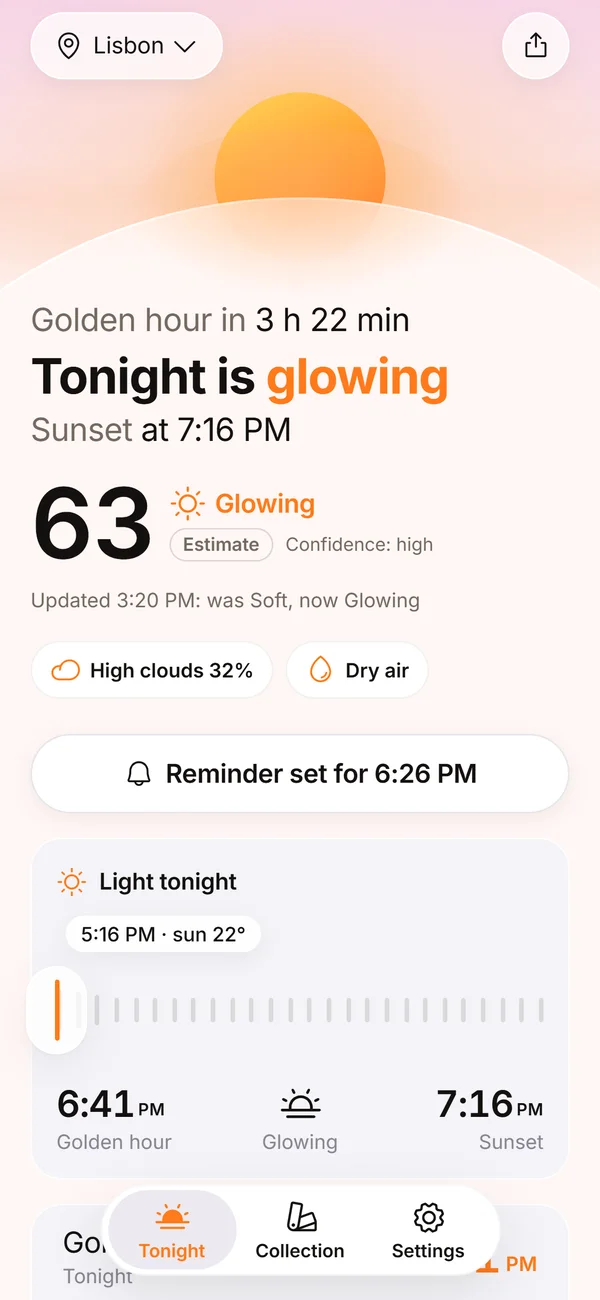
Three things. The first is clean air with good visibility, so the light is not blocked. The second is high or mid-level cloud that still sees the sun after the ground has gone dark. The third is a clear path to the west, because the glow depends on the sun still lighting the sky from below the horizon. These are the same factors in the Glow Score: high clouds, clear to the west and dry air.
- Thin high clouds that hold light.
- A gap in low clouds to the west.
- Dry air with good visibility.
- A location with a wide view and no city glare.
Why does the purple often get missed?
Because people leave when the sun goes down. The strongest purple arrives 10 to 25 minutes after sunset, when the sky is dimmer and the light is subtle. It is also easier to see away from bright street lights. Waiting at a quiet spot lets your eyes adjust, and the colors become more vivid as the contrast with the darker ground grows.
Why is the purple sometimes missing?
Several reasons. A thick cloud deck blocks the light from below and gives only a gray dusk. Heavy haze spreads the glow into a brownish smear, and city lights wash out the faint colors. On a very clear evening with no cloud at all, the afterglow is present but smooth, with little to see except a gradient from yellow to blue. The best purples often need thin cloud that the sun is still lighting.
Are there historical purple skies?
After large volcanic eruptions, fine particles in the upper atmosphere have produced brilliant purple and red twilights that returned night after night for months. The effect is the same afterglow scaled up, with a high layer of particles catching light long after the ground has gone dark. Ordinary evenings do a smaller version of the same thing with thin cirrus.
What is a simple plan to catch the purple?
Check the sky before you leave, and stay later than you think you should.
- Check the forecast for high clouds and a clear western horizon.
- Arrive 20 minutes before sunset at a place with an open view.
- Watch the sunset, then keep watching.
- At 10 minutes after sunset, look west and up for purple and rose.
- At 15 to 20 minutes after, turn east for the pink band.
Is purple the same as the blue hour?
They overlap but they are different. Blue hour is a cooler, more even blue as the sun reaches about 4 to 8 degrees below the horizon, and it is explained in what is blue hour. The purple afterglow comes just before it and sits nearer the horizon, with more red in the mix.
How do I photograph the afterglow?
Use Night mode if your iPhone offers it, steady the phone, and keep the exposure a little low so the purples stay rich instead of turning gray. Tap the brightest band, then slide the exposure down until the colors look deeper than they appear on screen. Take a few frames at different exposures and choose the one that matches the evening. See the full routine in how to photograph a sunset with an iPhone.
Can I keep the purple in a log?
Afterhue reads five colors from a sunset photo and keeps them in a numbered Hue Chip. A photo taken within the window around sunset gets an At sunset badge. Purple evenings often produce chips with a lilac and rose, and the app generates names such as Lilac Afterglow for palettes like that. The Sky Strip shows each of them as a stripe over the year.
Frequently asked questions
Why is the sky purple after sunset?
Red light from the sun below the horizon mixes with the blue twilight sky, and your eye reads the blend as purple or violet.
How long does the purple glow last?
Roughly 20 to 30 minutes after sunset, while the sun is 2 to 6 degrees below the horizon.
What is the afterglow?
The glow that stays in the sky after the sun has set, often purple and pink, caused by reddened light scattered in the upper atmosphere.
Is a purple sky a sign of weather?
Not a reliable one. It reflects how clean the air and high clouds are, and the old rhyme about red skies has more to do with air masses.
How can I catch more purple skies?
Stay 20 minutes after sunset at a spot with a clear western horizon, and check a score that shows high clouds and clean air.
Keep exploring
 Sunset Glow Score0 to 100, four bands, up to three reasons, and a score that learns from your ratings.Sunset Colors in OrderThe colors of a sunset from the horizon up and from the first gold light to blue hour.